
If you grew up Italian-American (or you’ve been cooking “Italian-style” in the U.S.), you’ve probably seen this pattern everywhere:
“Add 6 cloves of garlic.”
“More garlic = more Italian.”
“If you can’t smell it across the house, it’s not authentic.”
Here’s the honest, once-and-for-all truth:
In Italy, garlic is usually used moderately — and in many dishes it’s removed before serving.
Not because Italians dislike garlic. Not because it’s “wrong.”
But because traditional Italian cooking is built on balance, clarity, and letting the main ingredient shine.
Why This Confuses Americans and Italian-Americans
Italian-American cuisine has its own beautiful identity — bold, comforting, and generous. Over time, especially in immigrant communities, flavors often became stronger and bigger (for many reasons: available ingredients, feeding large families, making food feel rich and satisfying).
So it makes sense that in the U.S., garlic became a main character.
But in everyday kitchens in Italy, garlic is more often treated like a perfume:
it enhances
it doesn’t dominate
it supports the dish instead of becoming the dish
How Garlic Is Commonly Used in Italy (The Real Technique)
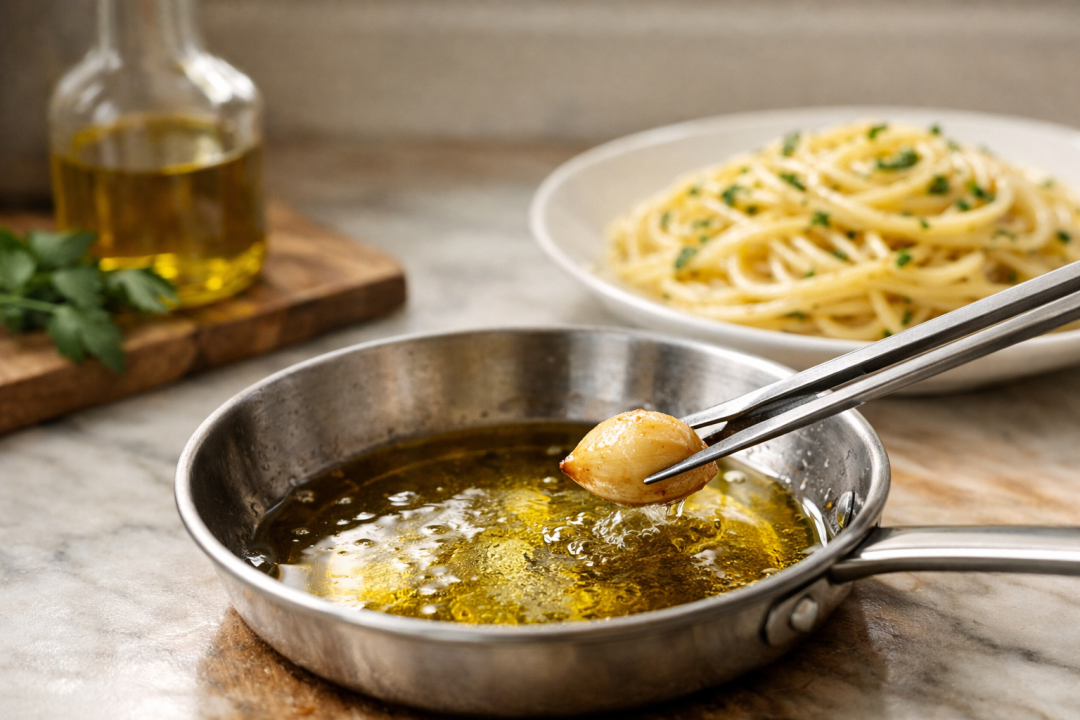
The Classic Method: “Garlic-Infused Oil”
In countless Italian recipes, garlic is used like this:
Warm extra-virgin olive oil gently
Add one whole garlic clove (often slightly crushed, sometimes “in its jacket”)
Let it perfume the oil without browning
Remove it once it has done its job
What you get is:
a subtle, savory aroma
a deeper flavor base
no harsh garlic bite
no heavy aftertaste
This Is the Key Point:
The flavor stays — the garlic often doesn’t.
Why Italians Often Remove the Garlic
1) Italian cooking is about balance
Traditional Italian recipes are designed so you can taste:
the tomato
the seafood
the greens
the beans
the olive oil
the cheese
When garlic is too strong, it can flatten the whole dish into one note: GARLIC.
2) Garlic can overpower delicate ingredients
This matters a lot in Italy, especially with:
seafood
vegetables
simple pasta dishes
broths and legumes
When the ingredient is delicate, garlic is used with a lighter hand — often just to perfume the oil.
3) It’s also about digestibility
Many Italian home cooks will tell you plainly:
too much garlic can feel heavy.
So the technique of using it whole and removing it is a practical tradition, not a snobby rule.
“But I’ve Been to Italy and Had Garlic!”
Absolutely. Italy is not one kitchen — it’s 20 regions and thousands of local traditions.
Garlic does get eaten in Italy — but context matters
There are dishes where garlic is meant to be present, especially in:
rustic countryside cooking
certain Southern regional recipes
bold sauces and stews
dishes where garlic is rubbed on bread or used as a background bite
But even then, the typical approach is still:
less “raw garlic punch”
more “rounded aroma”
more restraint than the average U.S. “Italian-style” recipe
The Biggest Myth: “More Garlic = More Authentic”
Authentic Italian flavor isn’t about intensity — it’s about clarity.
Italian cooking often aims for:
few ingredients
high-quality ingredients
clean technique
the right amount, not the maximum amount
So the most Italian thing you can do isn’t adding more garlic.
It’s knowing when garlic belongs, how much is enough, and when to let the dish breathe.
A Simple Rule You Can Actually Use at Home
If you want your food to taste “more Italy” and less “garlic bread,” try this:
Use 1 whole clove for the oil
Infuse gently
Remove it before you add the main ingredients
Taste — then decide if you truly need more
Most of the time, you’ll be shocked by how flavorful it is without the garlic taking over.
Quick Examples Where Italians Often Remove the Garlic
Pasta aglio e olio (yes, even here sometimes!)
Depending on the family and region, some use sliced garlic and eat it — others infuse with a whole clove and remove it to keep it light and elegant.
Seafood pasta
Garlic is frequently used to perfume the oil, then removed so the seafood stays the star.
Sautéed greens (broccoli rabe, chicory, spinach)
Often: whole garlic clove + oil + chili flakes → remove clove → add greens.
Beans, soups, and stews
Garlic may be used lightly, sometimes whole, sometimes in a soffritto — but rarely in the “six cloves minced” style.
Respecting Both Traditions (Because This Matters)
Let’s be clear: Italian-American cooking is real culture.
It’s history, family, survival, celebration, Sunday sauce, holidays, church basements, big tables, and loud laughter.
This post isn’t about saying “you’re doing it wrong.”
It’s simply explaining something that’s true in most Italian home cooking:
In Italy, garlic is often used as an aromatic — and very often removed.
That’s why many dishes in Italy taste:
lighter
cleaner
more ingredient-forward
and surprisingly more elegant
The Line to Remember 🇮🇹
Garlic in Italy isn’t the lead singer.
It’s the background music.
Use it to perfume. Use it with intention.
And when in doubt?
Let the ingredients speak.

No Comments