
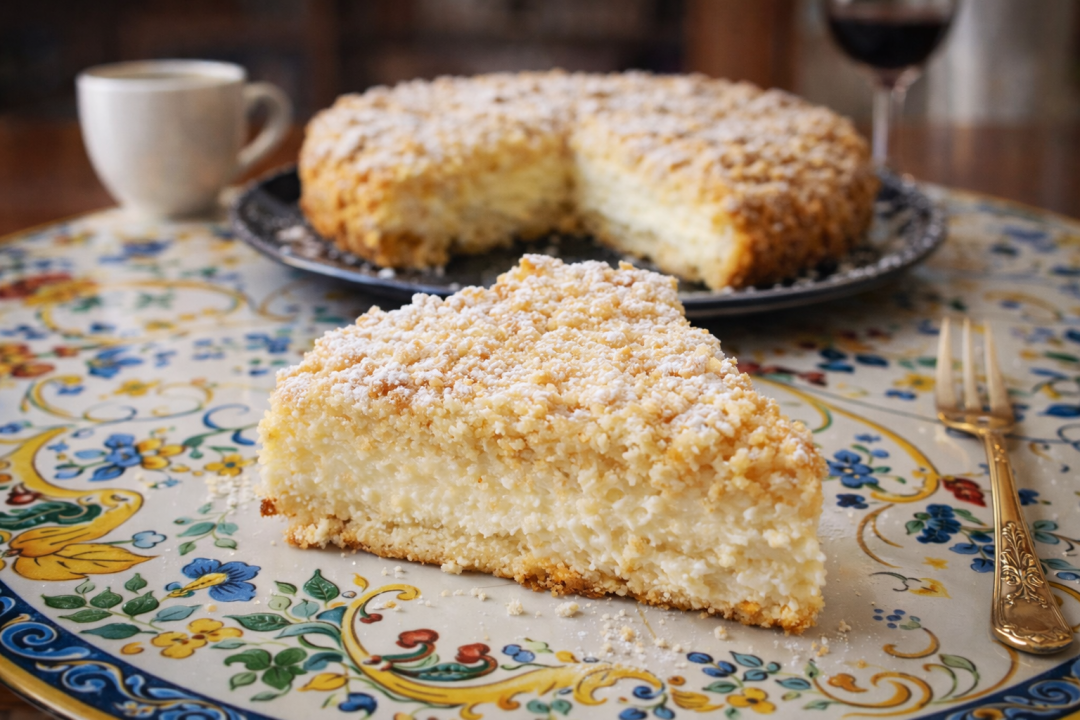
This traditional Italian Ricotta Sbriciolata is one of those simple desserts that tastes like it came straight from Nonna’s kitchen.
A buttery, tender crumb crust surrounds a creamy ricotta filling scented with vanilla and a hint of lemon.
Unlike a traditional pie crust, the dough is intentionally crumbly: part of it is pressed into the bottom of the pan, while the remaining crumbs are scattered over the ricotta filling.
The result is a rustic Italian cake with a crisp, buttery top and a soft, creamy center that practically melts in your mouth.
The secret is not to overwork the dough. It should look like coarse crumbs rather than a smooth pastry dough.
🖨️ PRINT OR DOWNLOAD PDF OF THIS RECIPE HERE:
Nonnas_Ricotta_Crumb_Cake_Sbriciolata_Recipe
Recipe Information
Prep Time: 20 minutes
Cook Time: 40–45 minutes
Cooling Time: 1–2 hours
Total Time: About 2 hours 30 minutes
Servings: 8–10
Pan: 8-inch (20 cm) springform pan
Ingredients
For the Crumb Dough
- 2 1/2 cups (300 g) all-purpose flour
- 1/2 cup (100 g) granulated sugar
- 1 teaspoon baking powder
- 1/4 teaspoon fine salt
- 8 tablespoons (1/2 cup / 113 g) unsalted butter, cold and cut into small cubes
- 1 large egg
- 1 teaspoon vanilla extract
For the Ricotta Filling
- 2 cups (about 16 oz / 450–475 g) whole-milk ricotta, very well drained
- 1/2 cup (60 g) powdered sugar
- 1 large egg
- 1 teaspoon vanilla extract
- Finely grated zest of 1 lemon
- 1/4 teaspoon ground cinnamon, optional
For Finishing
- Powdered sugar, for dusting
Important: Drain the Ricotta
For the best texture, the ricotta should not be watery.
Place the ricotta in a fine-mesh strainer set over a bowl and refrigerate for at least 1 hour. If your ricotta is particularly moist, let it drain for several hours or overnight.
This prevents the filling from becoming too loose and helps the cake slice cleanly once cooled.
How to Make Italian Ricotta Sbriciolata
1. Prepare the Pan
Preheat the oven to 350°F (175°C).
Grease an 8-inch (20 cm) springform pan and line the bottom with parchment paper.
Set aside.
2. Make the Crumb Dough
In a large bowl, whisk together the flour, sugar, baking powder, and salt.
Add the cold cubed butter.
Using your fingertips, rub the butter into the flour mixture until you have coarse, irregular crumbs.
The mixture should resemble coarse sand with some pea-sized pieces of butter.
Do not expect the mixture to come together into a smooth dough.
Add the egg and vanilla extract.
Gently mix with your fingertips until moist crumbs begin to form.
When you squeeze a handful of the mixture in your palm, it should hold together, but it should still crumble easily when broken apart.
If your flour was measured very densely and the mixture seems unusually dry, add 1 teaspoon of cold water at a time, only if necessary.
Do not overwork the dough.
Food Processor Option
You can also prepare the crumb mixture in a food processor.
Pulse the flour, sugar, baking powder, and salt briefly.
Add the cold butter and pulse several times until coarse crumbs form.
Add the egg and vanilla and pulse only until the mixture begins forming moist crumbs.
Do not process it into a smooth ball of dough.
3. Prepare the Ricotta Filling
In a medium bowl, combine the well-drained ricotta and powdered sugar.
Mix until creamy.
Add the egg, vanilla extract, lemon zest, and cinnamon if using.
Mix just until smooth and combined.
Do not overbeat the filling.
4. Form the Bottom Crust
Transfer approximately two-thirds of the crumb mixture to the prepared springform pan.
Spread it evenly over the bottom.
Using your fingers or the bottom of a measuring cup, gently but firmly press the crumbs into an even layer.
Press a small amount approximately 1/2 inch up the sides of the pan.
The base should hold together when pressed, but it does not need to look like traditional rolled pastry.
5. Add the Ricotta Filling
Spoon the ricotta mixture over the crust.
Spread it gently into an even layer, leaving a small border around the edge.
6. Add the Crumb Topping
Scatter the remaining crumb mixture evenly over the ricotta filling.
Do not press the topping down.
You want irregular crumbs on the surface so they become golden and crisp as the cake bakes.
7. Bake
Bake in the preheated oven for approximately 40–45 minutes.
The cake is ready when:
- the crumb topping is lightly golden;
- the edges are slightly deeper in color;
- the ricotta filling looks set rather than liquid;
- the center may still have a very slight jiggle.
Do not overbake, or the ricotta filling may become dry.
8. Cool Completely
Remove the cake from the oven and place the pan on a wire rack.
Allow it to cool in the pan for at least 1 hour.
For the cleanest slices, let it cool completely before removing the springform ring.
You can also refrigerate it for 1–2 hours before slicing if you prefer a firmer ricotta filling.
Do not attempt to transfer or slice the cake while it is still hot.
9. Finish and Serve
Once completely cooled, remove the cake from the pan.
Transfer it to a serving plate.
Dust generously with powdered sugar just before serving.
Serve at room temperature or slightly chilled.
NONNA’S TIPS FOR THE PERFECT SBRICIOLATA
The dough should stay crumbly
This is the most important part of the recipe.
Sbriciolata literally refers to its crumbly texture. You are not making a smooth pie crust or traditional pasta frolla.
The mixture should form moist crumbs that stick together only when pressed.
Measure the flour correctly
For US cup measurements, spoon the flour lightly into the measuring cup and level it with a knife.
Do not scoop the flour directly from the bag, as this can compact it and add significantly more flour to the recipe.
For the most consistent result, use the metric measurement: 300 grams.
Use cold butter
Cold butter creates the delicate, crumbly texture that makes sbriciolata special.
Do not melt or soften the butter.
Drain the ricotta
This step is essential.
Wet ricotta can make the filling loose and may prevent the bottom crust from baking properly.
Let it cool before slicing
The ricotta filling continues to set as it cools.
For beautiful slices, patience makes a big difference.
FLAVOR VARIATIONS
Vanilla and Almond Ricotta Sbriciolata
For a bakery-style almond aroma, replace the cinnamon with:
- 1 teaspoon vanilla extract
- 1/4 teaspoon almond extract
Almond extract is powerful, so use it sparingly.
Lemon Ricotta Sbriciolata
For a brighter citrus flavor, use:
- zest of 2 lemons
- 1 teaspoon vanilla extract
Omit the cinnamon.
Chocolate Chip Ricotta Sbriciolata
Fold 1/2 cup mini chocolate chips into the ricotta filling before assembling the cake.
For best results, chill the chocolate chips beforehand.
Orange Ricotta Sbriciolata
Replace the lemon zest with finely grated orange zest.
A small amount of finely chopped dark chocolate also pairs beautifully with orange and ricotta.
STORAGE
Store leftover Ricotta Sbriciolata covered in the refrigerator for up to 3–4 days.
For the best flavor and texture, remove individual slices from the refrigerator approximately 15–20 minutes before serving.
CAN I FREEZE RICOTTA SBRICIOLATA?
Yes.
Allow the cake to cool completely, then wrap individual slices tightly and freeze for up to 1 month.
Thaw overnight in the refrigerator.
The crumb topping may soften slightly after freezing, but the flavor remains excellent.
APPROXIMATE NUTRITIONAL INFORMATION
Based on 10 servings.
| Nutrient | Amount per Serving |
|---|---|
| Calories | Approximately 360–390 kcal |
| Carbohydrates | 42 g |
| Protein | 9 g |
| Fat | 18 g |
| Saturated Fat | 10 g |
| Sugar | 18 g |
| Fiber | 1 g |
| Sodium | 180 mg |
Nutritional values are approximate and will vary depending on the ricotta and other ingredients used.

2 Comments
Patty
2026-10-03 at 8:45 pmNonna never would’ve made this recipe because there’s no amount of mixing together that amount of butter and flour that ever would’ve made the dough come together enough for a crust. I had to add another tablespoon of butter and the egg yolk it said to put in the ricotta ( another error) to make it hold together. I also added a pinch of salt to the crumb mixture and used vanilla and almond extract instead of the cinnamon. Oh and forget that nonsense about mixing the butter and flour by hand. Use a mixer or food processor. This is a truly badly written recipe, one of my pet peeves…. but I don’t hold it against Nonna…. It was the person who erroneously transcribed the recipe. Thanks Nonna for trying.
Mangia with Nonna
2026-10-03 at 9:41 pmThank you for taking the time to leave such detailed feedback. You raised some fair points, especially about the crumb mixture and the need for clearer instructions.
I’ve now updated the recipe to make it more reliable and easier to follow. I slightly increased the butter, added a pinch of salt, clarified that the dough is meant to remain crumbly rather than come together like a traditional pie crust, and added clearer instructions for pressing the base into the pan. I also simplified the ricotta filling and added more precise guidance about draining the ricotta before using it.
The egg yolk in the original filling was not a transcription error, as similar variations do exist in Italian ricotta desserts, but I agreed that simplifying the filling makes the recipe more consistent for different types of ricotta.
I also kept the traditional hand-mixing method, while adding a food processor option for anyone who prefers it.
Thank you again for your feedback. Comments like yours are genuinely helpful, and I’m always happy to improve a recipe when something can be explained more clearly. ❤️🇮🇹