
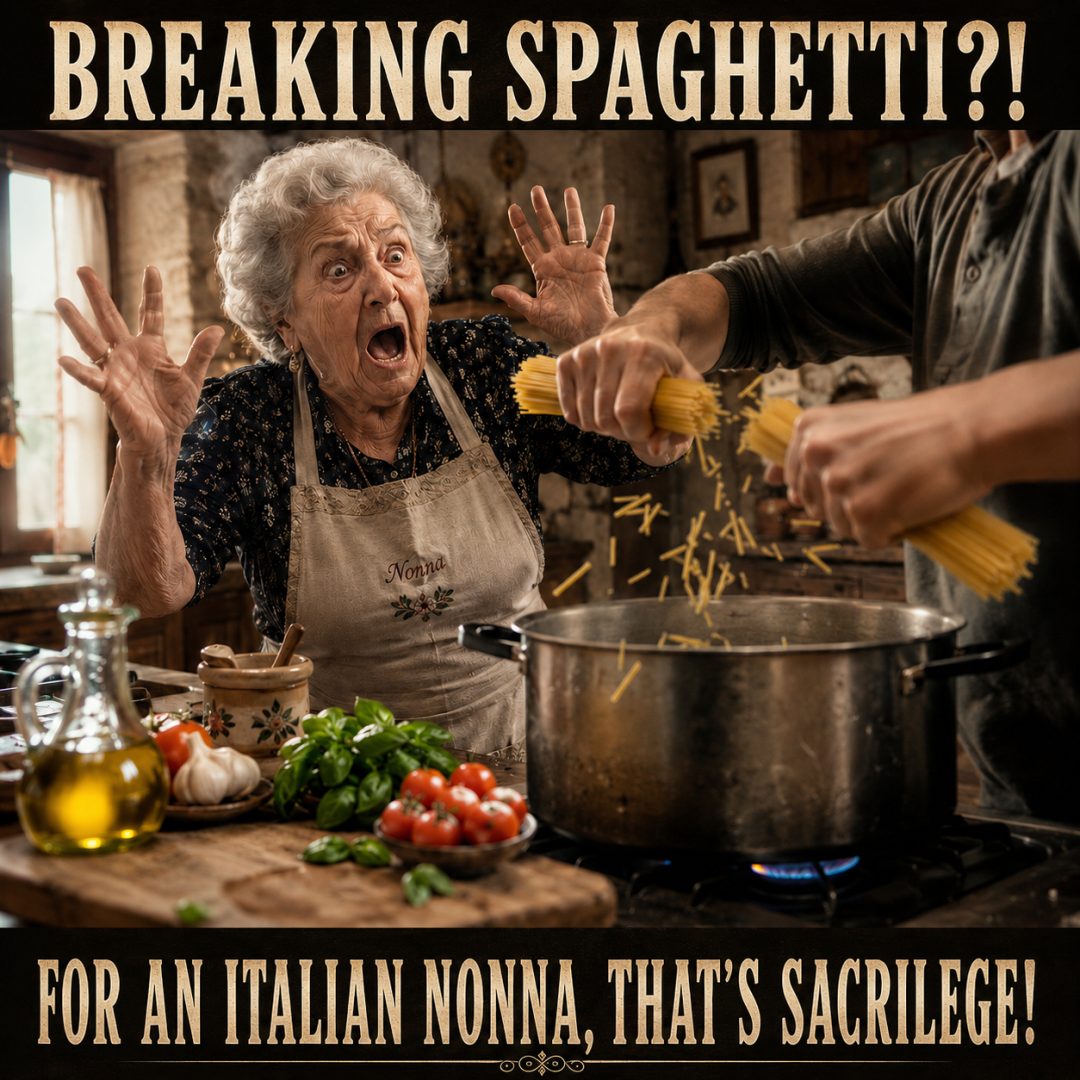
There are many things an Italian nonna can forgive.
A little too much garlic? Maybe.
Too much cheese? She will survive.
Forgetting to stir the sauce? She may raise an eyebrow.
But breaking spaghetti in half before putting it in the pot?
That is when the entire kitchen goes silent.
For many Italians, snapping spaghetti is not just a cooking shortcut. It feels like a tiny act of culinary rebellion — the kind of thing that makes every nonna clutch her apron and shout, “No, no, no!”
But why is breaking spaghetti considered such a big deal?
Let’s talk about it.
Spaghetti Is Meant to Stay Long
Spaghetti is designed to be long for a reason.
The length helps the pasta wrap beautifully around the fork, creating that perfect twirl everyone loves. When cooked whole, spaghetti holds the sauce properly and gives you the classic texture and bite that makes dishes like spaghetti al pomodoro, aglio e olio, carbonara, or spaghetti alle vongole so iconic.
When you break spaghetti, you lose that elegant twirl.
Instead of long strands that glide through the sauce, you end up with short, awkward pieces that behave more like broken noodles than true spaghetti.
And for an Italian nonna, that is a tragedy.
You Don’t Need to Break It to Fit the Pot
One of the most common reasons people break spaghetti is simple:
“It doesn’t fit in the pot.”
But here is the Italian truth: it will fit.
Place the spaghetti into boiling salted water and let the bottom part soften for a few seconds. Then gently press the rest down with a spoon or fork. Within moments, the spaghetti will slide naturally into the pot without any need for violence.
Nonna does not break the pasta.
Nonna waits ten seconds.
That is the difference between panic and tradition.
It Is About Respect for the Dish
In Italian cooking, pasta shapes matter.
Every shape has a purpose. Rigatoni catches thick meat sauces. Orecchiette holds vegetables and sausage. Penne works beautifully with creamy sauces. Spaghetti is made for sauces that cling to long strands.
So when spaghetti is broken, Italians often see it as disrespecting the shape and the dish.
It is not just pasta.
It is tradition.
It is memory.
It is Sunday dinner.
It is the sound of sauce bubbling while someone says, “The pasta is almost ready!”
That is why such a small gesture can feel so dramatic.
But Are Broken Spaghetti Ever Allowed?
Yes — and this is where things get interesting.
Broken spaghetti are not always forbidden. In many Italian homes, broken spaghetti are used in soups, broths, pasta e ceci, pasta e lenticchie, and especially pasta e fagioli.
In those dishes, short pieces of spaghetti make sense because they are eaten with a spoon and mixed into a creamy, comforting dish.
So the rule is simple:
Break spaghetti for soups and legumes.
Do not break spaghetti for a classic pasta dish.
That is the nonna-approved version.
Why Italian-Americans Love This Debate
For Italian-Americans, the “breaking spaghetti” debate is more than a cooking rule. It is a funny reminder of family, heritage, and the little traditions passed down from generation to generation.
Maybe your grandmother shouted from across the kitchen when someone touched the pasta.
Maybe your father insisted the water had to be “as salty as the sea.”
Maybe Sunday sauce was treated like a sacred ceremony.
These little rules may sound dramatic, but they are part of what makes Italian food so emotional and memorable.
Because in an Italian family, food is never just food.
It is love.
It is identity.
It is home.
And yes, sometimes it is also a nonna yelling because someone broke the spaghetti.
The Final Verdict
Is breaking spaghetti actually a crime?
No.
Will an Italian nonna act like it is?
Absolutely.
If you are making a traditional spaghetti dish, keep the pasta whole, let it soften into the pot, and enjoy the perfect twirl.
But if you are making pasta e fagioli or a cozy soup, go ahead and break it.
Just make sure Nonna knows why.
Nonna’s Rule
Long spaghetti for pasta dishes.
Broken spaghetti only for soups, broths, and pasta with beans.
Anything else?
That’s sacrilege. 🍝😄

No Comments