
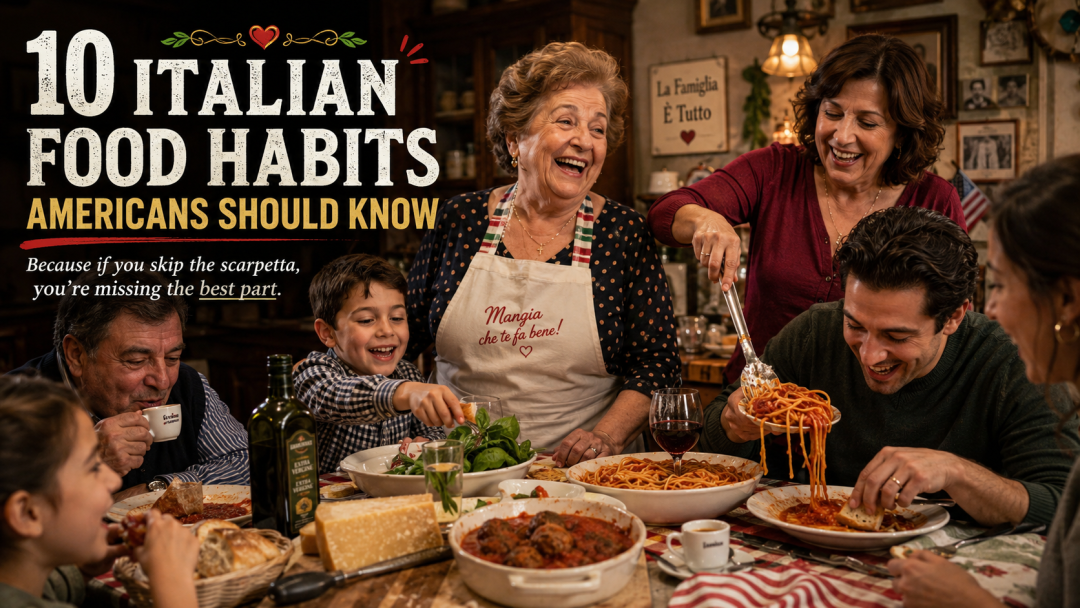
The little Italian traditions that make food taste even better
Italian food is not just about recipes.
It is about habits, rituals, memories, family rules, and tiny gestures that make every meal feel special.
Some of these traditions may look funny to Americans at first. Others may feel instantly familiar, especially to Italian-Americans who grew up around Sunday sauce, loud family dinners, and Nonna watching every plate at the table.
Here are 10 Italian food habits everyone should know — especially if you love real Italian food.
10. Never Waste the Sauce
In Italy, sauce is not something you leave behind.
When the pasta is finished and there is still a little sauce on the plate, many Italians reach for a piece of bread and wipe it up. This is called fare la scarpetta.
It is simple, delicious, and deeply Italian.
To some people, it may look informal. To Italians, it often means one thing:
the food was too good to waste.
9. Pasta Is Usually a First Course, Not the Whole Meal
In many American homes, pasta is the main event. A huge bowl of spaghetti can be dinner by itself.
In Italy, pasta is traditionally served as a primo piatto, or first course. After that, there may be meat, fish, vegetables, salad, fruit, or dessert.
Of course, many Italians today also eat pasta as a full meal at home. But traditionally, pasta has its own place in the meal.
That is why Italian portions are often smaller than American restaurant portions.
8. Cheese Does Not Go on Everything
This one may shock some people.
In Italy, Parmigiano Reggiano is loved and respected, but it does not go on every dish.
For example, many Italians do not add grated cheese to seafood pasta. Spaghetti with clams, seafood linguine, or shrimp pasta are usually enjoyed without cheese because the delicate flavor of the sea should remain the star.
Of course, every family has its habits. But in traditional Italian cooking, cheese is used with intention, not automatically.
7. Bread Is for the Meal, Not Usually Before the Meal
In many American restaurants, bread arrives before the food with butter or olive oil.
In Italy, bread is usually eaten with the meal. It helps accompany vegetables, meats, stews, and sauces.
And yes, it becomes very important at the end of the meal when the scarpetta moment arrives.
Bread is not just a starter.
Bread is part of the table.
6. Cappuccino After Dinner Is Not Very Italian
Many Americans love cappuccino any time of day.
In Italy, cappuccino is usually a morning drink, often enjoyed with a cornetto or something sweet for breakfast.
After lunch or dinner, Italians usually order an espresso.
Why? Because cappuccino is considered too milky and heavy after a full meal.
Will someone stop you from ordering it? Probably not.
Will Italians notice? Absolutely.
5. Sunday Lunch Is Sacred
For many Italian families, Sunday lunch is not just a meal. It is a weekly ceremony.
There may be pasta, meat sauce, baked dishes, roasted meats, vegetables, wine, fruit, coffee, and dessert.
But the real ingredient is family.
This is the meal where stories are repeated, arguments happen, children run around, and someone always says:
“Eat, eat, you’re too skinny.”
That is Sunday lunch.
4. The Best Recipes Are Often Not Written Down
Ask an Italian grandmother for a recipe and you may hear:
“A little bit of this.”
“Enough flour until it feels right.”
“Cook it until it is ready.”
“You’ll know.”
Italian cooking is full of measurements, but it is also full of memory, instinct, and experience.
Many family recipes were never written in a notebook. They were learned by watching, tasting, helping, and sitting in the kitchen while someone older cooked.
That is why these recipes feel so precious.
3. Simple Food Is Not Boring Food
One of the biggest secrets of Italian cooking is simplicity.
A plate of pasta with tomato, garlic, olive oil, and basil can be unforgettable when the ingredients are good and the technique is right.
Italian food does not need to be overloaded to be delicious.
Sometimes the most emotional dishes are the simplest ones:
pasta with beans, bread and tomato, spaghetti with garlic and oil, pastina in broth, or a slice of rustic bread with olive oil.
Simple does not mean poor.
Simple means honest.
2. Every Region Has Its Own Rules
There is no single “Italian food.”
Italy is a country of regions, villages, dialects, and family traditions.
What is normal in Sicily may be unusual in Lombardy. What is classic in Naples may be completely different from what people cook in Bologna, Rome, Bari, or Venice.
This is why Italians can argue for hours about carbonara, ragù, pizza, arancini, lasagna, pesto, and even how to cut vegetables.
Italian food is not one tradition.
It is hundreds of traditions living side by side.
1. Food Is Love, Memory, and Identity
For Italians and Italian-Americans, food is rarely just food.
It is Nonna’s kitchen.
It is Sunday sauce simmering for hours.
It is the smell of garlic in olive oil.
It is fresh bread on the table.
It is cousins, parents, grandparents, loud voices, old stories, and one more plate even when you are already full.
Italian food connects generations.
That is why a simple dish can make people emotional.
Because sometimes you are not just tasting pasta.
You are tasting home.
Final Thoughts
Italian food habits may seem small, but they carry a lot of meaning.
They teach us not to waste, to slow down, to respect ingredients, to enjoy family, and to turn even the simplest meal into something memorable.
So next time you sit at the table, remember:
eat slowly, enjoy every bite, respect the sauce, and never forget the bread.
Because in Italy, the best part of the meal is often the part that happens at the very end.


No Comments