
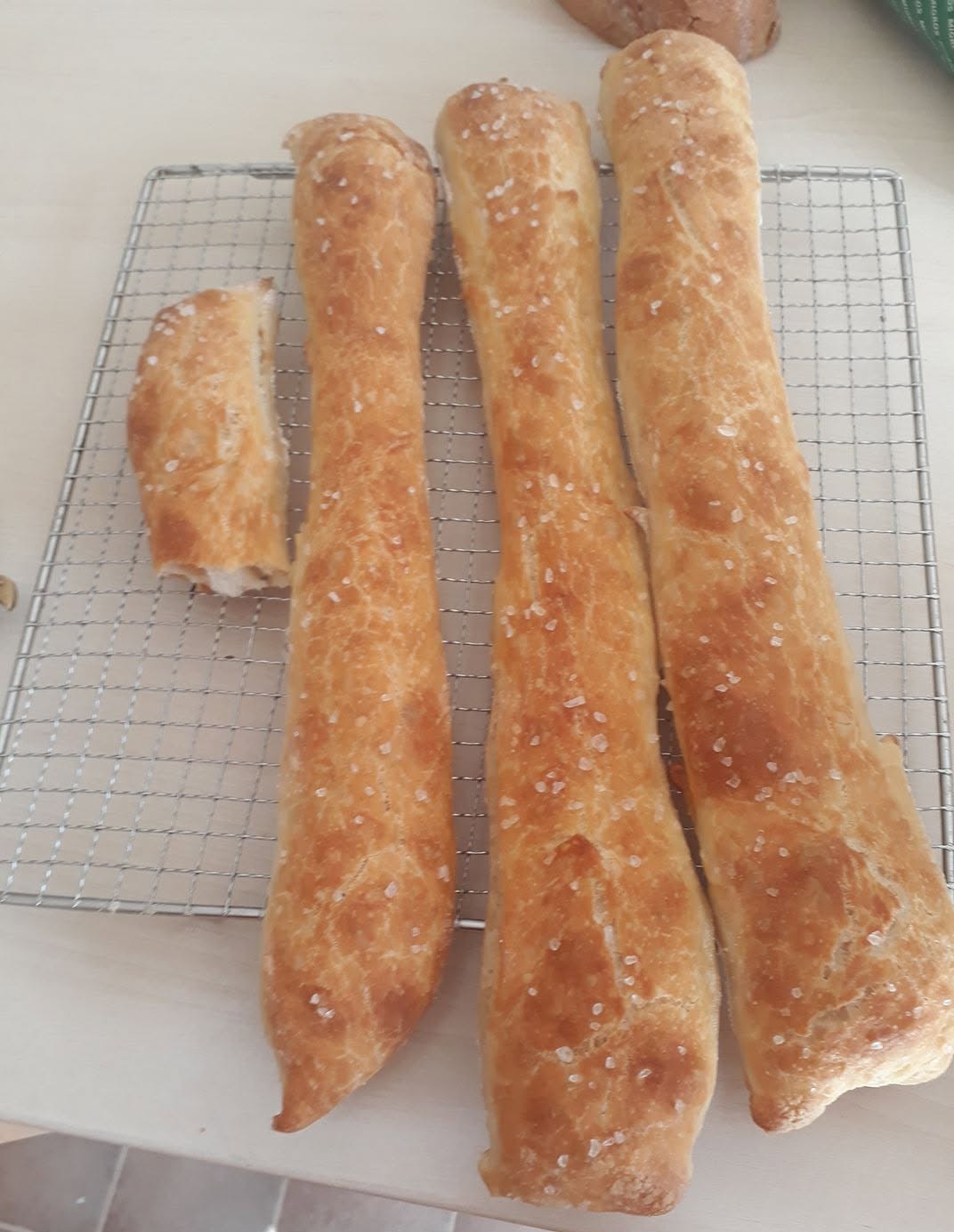
Some bread recipes ask for strong arms, a stand mixer, and plenty of kneading. This one asks mostly for patience.
Jim Lahey’s famous Stecca starts with an almost impossibly wet and sticky dough.
You stir it together in less than a minute, leave it alone overnight, and by the next day it has transformed into a bubbly, elastic dough ready to become four long, rustic loaves.
Once baked, the stecche have a thin, crisp crust, an airy interior, and the unmistakable flavor of extra-virgin olive oil and coarse sea salt.
Tear them apart while they are still slightly warm, use them for sandwiches, or place them in the middle of the table and watch how quickly they disappear.
🖨️PRINT OR SAVE PDF OF THIS RECIPE HERE:
jim_lahey_no_knead_stecca_bread_recipe_clean
🥖 Recipe Information
Servings: 8
Yield: 4 long stecca loaves
Prep Time: 15 minutes
First Rise: 12–18 hours
Second Rise: 1–2 hours
Bake Time: 15–25 minutes
Difficulty: Easy
🛒 Ingredients
- 3 cups bread flour (about 14 oz / 400 g), plus extra for dusting
- 1/2 teaspoon fine salt
- 3/4 teaspoon granulated sugar
- 1/4 teaspoon instant yeast or active dry yeast
- 1 1/2 cups cool water (about 12 fl oz / 350 ml)
- 1/4 cup extra-virgin olive oil, approximately, divided
- 3/4 teaspoon coarse sea salt
- Semolina flour or additional bread flour, for dusting
👩🍳 How to Make Jim’s Stecca Bread
1. Mix the Dough
Place the bread flour, fine salt, sugar, and yeast in a large mixing bowl.
Pour in the cool water and stir with a wooden spoon or sturdy spatula just until no dry flour remains.
There is no need to knead the dough.
It should look very wet, sticky, and somewhat rough. That is exactly what you want.
2. Let It Rise Overnight
Cover the bowl tightly with plastic wrap or a lid.
Leave the dough at room temperature for 12–18 hours.
By the end of the rise, it should have more than doubled in size and the surface should be covered with small bubbles.
3. Fold the Dough
Generously flour your work surface.
Using a dough scraper or spatula, gently ease the dough out of the bowl without pressing out all the air.
With floured hands, fold the dough over itself two or three times.
Shape it very gently into a loose, flattened round.
Do not knead it.
4. Second Rise
Lightly brush the top with extra-virgin olive oil and sprinkle with a small amount of the coarse sea salt.
Dust a clean kitchen towel generously with flour or semolina.
Place the dough on the towel and loosely cover it.
Allow it to rise for another 1–2 hours, or until noticeably puffy and almost doubled.
5. Preheat the Oven
About 30 minutes before baking, preheat the oven to:
500°F (260°C)
Place the rack in the center of the oven.
Generously brush a large rimmed baking sheet with extra-virgin olive oil.
6. Shape the Stecche
Transfer the risen dough carefully onto a floured work surface.
Divide it into 4 equal pieces.
Working gently so you do not deflate all those beautiful air bubbles, stretch each portion into a long, narrow strip approximately the length of your baking sheet.
The shape does not need to be perfect. In fact, the irregular rustic appearance is part of the charm.
Place the four stecche on the prepared baking sheet, leaving space between them.
7. Add Olive Oil and Sea Salt
Brush the surface generously with extra-virgin olive oil.
Sprinkle with the remaining coarse sea salt.
8. Bake
Bake for 15–25 minutes, depending on your oven, until the stecche are golden and crisp.
Watch them carefully during the final few minutes because the thin ends can brown quickly.
Transfer the bread to a wire rack and allow it to cool for at least 10 minutes before serving.
👵 Nonna’s Tips
Don’t add extra flour to the dough. It is supposed to be extremely wet and sticky. The high hydration is what helps create the large, irregular holes inside the bread.
Handle it gently. Once the dough has fermented overnight, all those bubbles are precious. Stretch rather than press when shaping the stecche.
Give it enough time. If the dough has not become bubbly and noticeably larger after 12 hours, simply give it a few more hours.
Use a very hot oven. The intense initial heat gives the bread its light interior and crisp exterior.
Don’t chase perfect shapes. Stecca is rustic bread. Slightly uneven loaves often look better once baked.
For maximum crunch, eat the bread the same day it is baked.
If the crust softens later, place the stecca in a 400°F (200°C) oven for 5–7 minutes and it will become crisp again.
🍅 Delicious Variations
Once you have mastered the basic version, try pressing a few ingredients gently into the surface immediately before baking:
- Halved cherry tomatoes
- Pitted olives
- Thinly sliced garlic
- Fresh rosemary
- Thyme
- Caramelized onions
Finish with a drizzle of extra-virgin olive oil before placing the stecche in the oven.
🍽️ How to Serve Stecca Bread
Serve it warm alongside:
- Pasta dishes
- Soups and stews
- Antipasto platters
- Prosciutto and Italian cheeses
- Fresh mozzarella and tomatoes
- Extra-virgin olive oil for dipping
It is also excellent sliced lengthwise and turned into a rustic Italian sandwich.
📊 Nutritional Facts
Approximate values per serving, based on 8 servings.
| Nutrient | Amount |
|---|---|
| Calories | 240 kcal |
| Total Fat | 7 g |
| Saturated Fat | 1 g |
| Carbohydrates | 38 g |
| Dietary Fiber | 1–2 g |
| Sugars | 1 g |
| Protein | 5 g |
| Sodium | 350–400 mg |
Nutrition values are estimates and may vary depending on the flour and amount of olive oil and salt used.



No Comments