
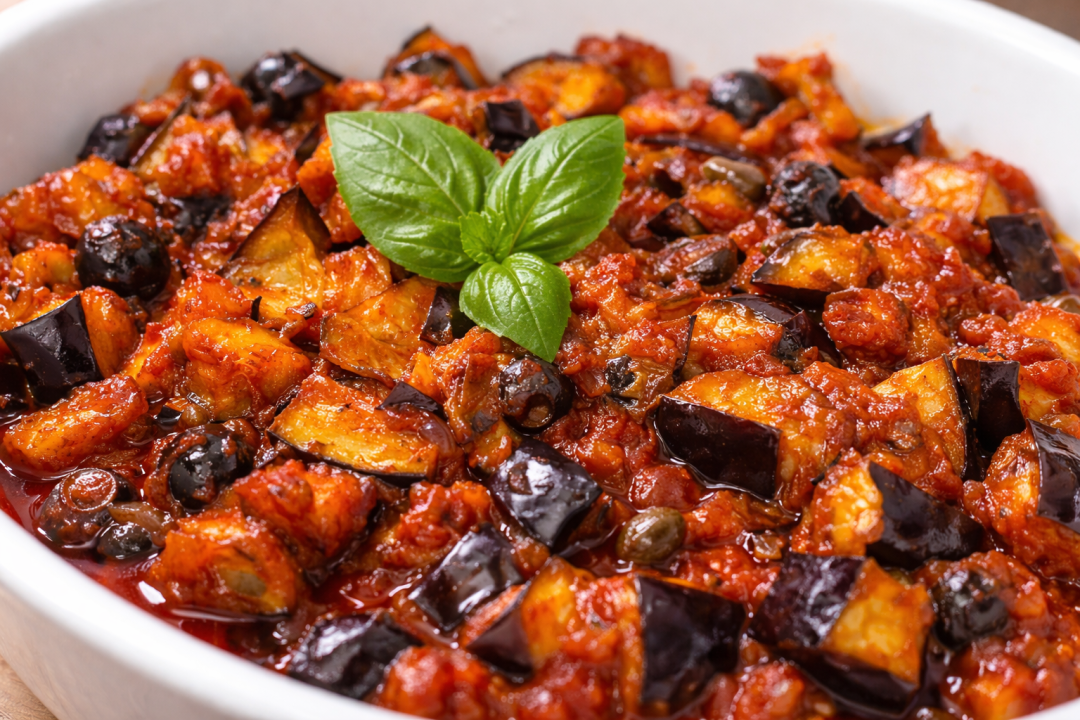
Sicilian Caponata is one of those dishes that tastes even better after it has had time to rest. Fried eggplant is combined with tomatoes, celery, onions, olives, and capers, then finished with the unmistakable Sicilian agrodolce balance of vinegar and sugar.
Every family in Sicily has its own version, but the heart of caponata is always the same: tender eggplant, savory vegetables, briny olives and capers, and that delicate sweet-and-sour finish that makes you keep going back for another bite.
Serve it at room temperature with crusty Italian bread, as an appetizer, a side dish, or part of an antipasto spread.
🍆 What Is Sicilian Caponata?
Caponata is a traditional Sicilian eggplant dish made with fried eggplant and vegetables cooked in a tomato-based sauce.
What sets it apart from other Mediterranean eggplant dishes is the agrodolce finish — a mixture of vinegar and sugar that gives caponata its characteristic sweet-and-sour flavor.
It can be served warm, but it is traditionally at its best at room temperature after resting for several hours.
🖨️ PRINT OR DOWNLOAD PDF OF THIS RECIPE:
🍽️ Servings
6 servings
Preparation Time
30 minutes
Cooking Time
40 minutes
Resting Time
At least 2 hours
Total Time
About 3 hours 10 minutes
🛒 Ingredients
- 2 large eggplants, about 2 pounds total
- 1 large yellow onion, finely chopped
- 3 celery stalks, sliced
- 1 can (14 oz) diced tomatoes
- ⅔ cup green olives, pitted and sliced
- 2 tablespoons capers, rinsed and drained
- ¼ cup pine nuts, optional
- 3 tablespoons white wine vinegar
- 1½ tablespoons granulated sugar
- ½ cup fresh basil leaves, roughly torn
- Extra virgin olive oil, as needed
- Vegetable or olive oil, for frying
- Salt, to taste
- Freshly ground black pepper, to taste
Optional Alternative for the Tomatoes
Instead of canned diced tomatoes, you can use about 14 oz ripe fresh tomatoes, peeled if desired and roughly chopped.
👩🍳 Instructions
1. Prepare the Eggplant
Wash the eggplants and cut them into approximately ¾-inch cubes.
Place the eggplant in a colander, sprinkle lightly with salt, and let it sit for about 20–30 minutes.
Pat the eggplant dry thoroughly with paper towels.
2. Fry the Eggplant
Heat about ½ inch of frying oil in a large skillet over medium-high heat.
Fry the eggplant in batches until tender and golden brown, about 4–6 minutes per batch.
Do not overcrowd the pan.
Transfer the cooked eggplant to a plate lined with paper towels and set aside.
3. Cook the Celery
Bring a small saucepan of lightly salted water to a boil.
Add the sliced celery and cook for about 3–4 minutes.
Drain and set aside.
This softens the celery slightly while allowing it to keep some texture.
4. Cook the Onion
In a large skillet, heat 2–3 tablespoons of extra virgin olive oil over medium heat.
Add the chopped onion and cook gently for about 5–7 minutes, until soft and translucent.
Do not let it brown too much.
5. Add the Tomatoes
Add the diced tomatoes to the skillet.
Season lightly with salt and black pepper.
Cook for about 10 minutes, stirring occasionally, until the tomatoes begin to break down and form a thick sauce.
6. Add Celery, Olives, and Capers
Add the cooked celery, green olives, and capers.
If using pine nuts, add them now.
Stir everything together and simmer for another 5 minutes.
7. Make the Agrodolce
In a small bowl, stir the white wine vinegar and sugar together until the sugar begins to dissolve.
Pour the mixture into the skillet.
Stir well and cook for about 2–3 minutes so the sharpness of the vinegar softens slightly.
Taste and adjust the balance if necessary.
Caponata should taste pleasantly sweet and sour, but neither flavor should overpower the other.
8. Add the Eggplant
Gently fold the fried eggplant into the sauce.
Cook over low heat for another 3–5 minutes, stirring very carefully so the eggplant pieces do not break apart.
Turn off the heat.
Add the fresh basil.
9. Let It Rest
Allow the caponata to cool completely.
For the best flavor, let it rest for at least 2 hours before serving.
Even better, refrigerate it overnight and bring it back to room temperature before serving.
👵 Nonna’s Tips
Don’t rush the resting time. Caponata tastes much better after the flavors have had time to come together.
Fry the eggplant in batches. Crowding the pan will cause the eggplant to steam instead of becoming beautifully golden.
Don’t overcook the eggplant. You want tender pieces that still hold their shape.
Adjust the agrodolce to your taste. Sicilian families vary the balance of vinegar and sugar. If you prefer it sharper, add a little more vinegar. If you prefer it sweeter, add a small pinch of sugar.
Use good-quality olives and capers. They contribute a lot of flavor to the finished dish.
Make it the day before. Caponata is one of those rare recipes that actually improves overnight.
🍞 How to Serve Sicilian Caponata
Serve caponata at room temperature with:
- Crusty Italian bread
- Crostini or toasted bread
- Grilled fish
- Roasted meats
- An Italian antipasto platter
- Fresh mozzarella
- Burrata
It can also be spooned over toasted bread for an easy Sicilian-style appetizer.
🧊 How to Store Caponata
Store leftover caponata in an airtight container in the refrigerator for up to 4 days.
Before serving, remove it from the refrigerator and let it sit at room temperature for about 20–30 minutes.
Freezing is possible, but it is not ideal because the eggplant can become softer and slightly watery after thawing.
📊 Nutrition Facts
Approximate values per serving.
| Nutrition | Amount |
|---|---|
| Calories | 260 kcal |
| Total Fat | 19 g |
| Saturated Fat | 3 g |
| Carbohydrates | 22 g |
| Fiber | 7 g |
| Sugars | 11 g |
| Protein | 4 g |
| Sodium | 520 mg |
Nutrition values are estimates and may vary depending on the amount of frying oil absorbed and the specific ingredients used.

2 Comments
maureen reynolds
2026-09-19 at 7:42 pmHi, your recipe calls for cherry tomatoes, but the instructions seem to call for regular treatment of paste tomatoes. Which should it be?
Mangia with Nonna
2026-09-20 at 7:12 amThank you so much for catching that! You’re absolutely right — that was an inconsistency in the recipe. For this caponata, I recommend using about 14 oz of canned diced tomatoes (or the same amount of ripe fresh tomatoes, chopped), rather than cherry tomatoes. I’ll update the recipe to make it clearer. Thanks again for pointing it out! 😊